 | ||||||||
| Stock Photo From Sig Sauer's Website |
Thursday, January 17, 2013
Sig 226 SAO, Finally.
http://sigsauer.com/CatalogProductDetails/p226-elite-sao.aspx
Been wanting one of these for years. Unlike the X5 Tactical, holsters will be readily available for this model.


Saturday, January 5, 2013
Chamber Empty Carry and Perfect Storm Scenarios
In the concealed carry world, we talk about different scenarios where one may find themselves drawing a firearm and defending themselves. Everything from home invasions, robberies, active shooter scenarios, multiple attackers, single attackers, female attackers and everything in between.
There are two distinct types of scenarios that are kind of dangerous to the mental physique of a concealed carrier. Those two are the Kobayashi Maru, AKA the un-winnable scenario (taken from Star Trek 2, the Wrath of Khan) and what I call the "Perfect Storm" scenario.
In the perfect storm scenario, every possible thing goes in favor of the defending party.
A "good" scenario needs to be somewhere in the middle, you should think about and plan for things going wrong and totally not the way that we would "want" it to go. Why? Stuff happens. Sure, the desired outcome is being victorious, but if all you think about is the perfect storm, you don't take into account a lot of variables that can effect a victorious outcome.
We would all like to think that on any given day that we may be called to draw and God forbid use our firearm that we will have crystal clear situational awareness, see the threat approaching from 20 yards away with a red neon sign indicating evil intent, have all the time in the world to sweep a concealment garment out of the way, draw the pistol, step into the text book stance of our liking, and aim in at the target ensuring proper sight alignment, sight picture and start tactical breathing all by the time the threat reaches that magic number of 21' so we can dispense a text-book Mozambique and save the day!
That's probably not the way it's going to happen.
The day that you end up needed to draw your pistol and fight for your life will probably be the day that your dog died, your wife left you for your best friend, you just found out that you're getting fired from your job and your favorite team is not going to the Super Bowl this year.
You're going to have things on your mind, you may see the guy approaching but so what, this day can't get any worse, maybe you even think "Man I wish this guy would try something so I could kick his ass!" and while you're day dreaming, playing THAT scenario out with a grin on your face the dude is now inside your space and straight jacks you in the jaw and THEN you're trying to go for your gun etc.
So where am I going with this? Some of the individuals in the "Carry Community" take these things this into account: what if I don't see it coming, what if I'm injured, what if I'm out numbered, what if.... lack of good lighting, clear threat indicators, etc. We think about things from the worst possible angle, not the best. Lets be honest, if we even have to draw our gun, any hopes of an easy way out of this situation has all ready gone up in smoke and we've just won the lottery of shitty luck, and it's probably not going to get any better.
But if there's one group of people that seem to glance over this it's the "Chamber Empty" or Condition 3 Crowd. Condition Three, or C3 is the weapons condition code for loaded magazine in the firearm, but the chamber is empty requiring manual preparation of the firearm (Most often manually cycling the slide) before the gun can be used.
The most common means of getting the firearm ready for action is to use the support hand to manipulate the slide. That's pretty easy, after all that's pretty much what a lot of people do to load the gun in the first place or it's what many do when facilitating a slide lock or emergency reload.
The main-stay of most C3 carriers regarding this is that "it only takes a second (on a static range, at a non moving target, in optimal conditions) to get the slide moving and chamber a cartridge."
I speculate that many have never tried this with gloves on or in the rain with wet hands, or better yet on their back with their support hand keeping an attacker at bay. Never mind the fact that they are relying on an appendage that may not be available when in need to operate that gun. What if the first indication of an attack is a ball bat striking your support side elbow? What if the threat is pretty close, lets give it the ideal Tueller range of 7 yards and your attacker rushes you and now you're trying to get off the X. When you start rapidly moving your hands tend to travel in opposite directions. You can fumble the loading process by short stroking the slide and now have a JAMMED gun.
If the stats are to be believed, an average gunfight is supposed to be 3yards, 3-5 shots, and be over in 3-5 seconds. Do you want one third of that time (assuming all the ideal conditions have been met) spent trying to get your gun ready to shoot back?
If you are responding with lethal force, you are all ready behind the power curve, you are even further handicapped with a firearm in that is not ready to be fired.
I can understand many that are new to carry or maybe even shooting in general to be....concerned with Condition One (C1-- loaded magazine inserted, cartridge in chamber, firearm on safe (if equipped with one)). For the most part that will wear off with time as training is obtained and the shooter's comfort level increases. But there are some that should know better than to cling to C3 carry as as a "safer" method of carry. Their claim is that there is no possible chance of negligent discharge. While that is true, there's also a lesser chance of an INTENTIONAL discharge.
Provided that proper equipment and gun handling is being used, a firearm carried C1 is just as "safe" as a firearm being carried C3.
Just today I read the following from two members of a gun forum:
Um No. I practice racking with left hand as I get on target. Pretty fast after all these years. No write [right] or wrong here. I just do it the same EVERY time.
AND
Most of the time I don't carry with one in the chamber either, as I posted quite a while ago. Some people don't realize exactly how quickly you can chamber a round if they don't practice it much, if at all. Don't have to worry about ND/AD at all (as long as we treat them like they are loaded every time), if a bg (or even a child) somehow gets your gun it will not fire without racking the slide, no bullet setback. There's a lot more benefits too but I don't have time to list them atm. As long as you practice, it makes no difference how you carry, anyone who thinks otherwise hasn't practiced it enough.
Regarding the first statement, if this chambering process is done the same "every time" how will this process be effected when it CAN'T be done the same way as practiced? What about the possibility of fending off an attacker while drawing a firearm? Lets take the human threat aspect out of this, as much as the concealed carry loves "dog topics," I hate them but lets go there for a second.
What if you're being mauled by that viscous poodle from down the street and your support hand or "weak hand" is now an effective chew toy that managed to keep the dog from latching to your throat? How will you chamber a round then?
Now, I don't put a whole lot of weight into this being something that everyone needs to worry about. There are lots of other possibilities and what ifs and it doesn't take a big imagination to create possible scenarios that would hamper one's ability to defend themselves with an unloaded gun.
I did ask the author of the first statement what he would do should he suffer an injury such as a broken arm, sprained wrist, or shoulder injury and he replied with something along the lines of if aliens removed his arm in his sleep that he would carry with a round in the chamber. Do you really think he's taking carry seriously if he can't even factor in real life injuries? All that time spent doing one way of loading that gun with his support hand is one fall off a ladder, one slip on an icy drive, or one sports injury away from being completely irrelevant.
In the event that the support hand is tied up, many will advocate a rear sight that will facilitate one handed racking of the slide. The idea is not relegated solely to the C3 crowd. It's "tactical" to be able to do this and I will admit that most of my guns have this capability. It's mainly done for malfunction clearing should the support hand be injured, etc. Doing this on the draw can be problematic depending on mode of carry and location. It can add excessive movement to a draw stroke. Remember that 1 second time to chamber a round being 1/3 of a gun fight? That one second grows to 1.5, to 2 seconds pretty quick when the process becomes more complicated. Using the rear sight of a pistol to cycle the slide will depend on a lot of variables going right to do it under stress. That rear sight isn't very large and you need an object or surface to use in conjunction with that rear sight.
Regarding the second, italicized statement, I think that the reason that every single professional instructor out there advocates carrying with a round in the chamber is that they have "practiced" enough to see the huge disadvantages and training gaps associated with carrying a firearm C3 for self defense. I would think that if some TRAINING were added to supplement the "practice" and a little more knowledge be learned about how sudden a situation can develop, fight continuum, getting off the "X" and close quarters defense etc. that attitude might change.
I'm very big on solidarity regarding weapons functionality. I don't want to have a draw stroke process that is different or X, Y, and Z. Getting your gun out of the holster and into play should should be A+B=C, not solve for X.
Sunday, November 25, 2012
Squeak, squeak, squeak....SSP Expert
That was the sound of me squeaking by and shooting Expert in SSP at today's IDPA classifier.
120 is the minimum score (smaller number is better score) to make the cut, I shot a 119.99.
What's more amazing is that I shot was is now my best classifier with a gun I had never shot before this morning in 20-30 degrees of weather...I wonder what I can do with the gun in warm weather?
As my P30S is no longer IDPA complaint, I wanted a similar gun that I could shoot at a match without question.
I lucked into a P30LS in LEM that had all ready had a Gray Guns trigger job and the Heinie sights that I prefer. The pistol was received on Wednesday night and with all the Holiday and other activities I didn't get a chance to shoot the pistol until arriving at the range this morning. I got to shoot 20rds on the plate rack and the rest was all on the classifier.
For me it was a great end to the 2012 IDPA season, I went in to 2012 wanting to make Expert, but I planned on doing it in the Custom Defense Pistol (CDP) division, never thought in a million years I'd be doing with a P30LS in LEM in SSP.
As stated, this was our last IDPA match for 2012.
Much thanks goes out to those that helped us at BHPC with successful 2012 IDPA Season.
Back to the drawing board for stages to shoot in 2013!!!
120 is the minimum score (smaller number is better score) to make the cut, I shot a 119.99.
What's more amazing is that I shot was is now my best classifier with a gun I had never shot before this morning in 20-30 degrees of weather...I wonder what I can do with the gun in warm weather?
As my P30S is no longer IDPA complaint, I wanted a similar gun that I could shoot at a match without question.
I lucked into a P30LS in LEM that had all ready had a Gray Guns trigger job and the Heinie sights that I prefer. The pistol was received on Wednesday night and with all the Holiday and other activities I didn't get a chance to shoot the pistol until arriving at the range this morning. I got to shoot 20rds on the plate rack and the rest was all on the classifier.
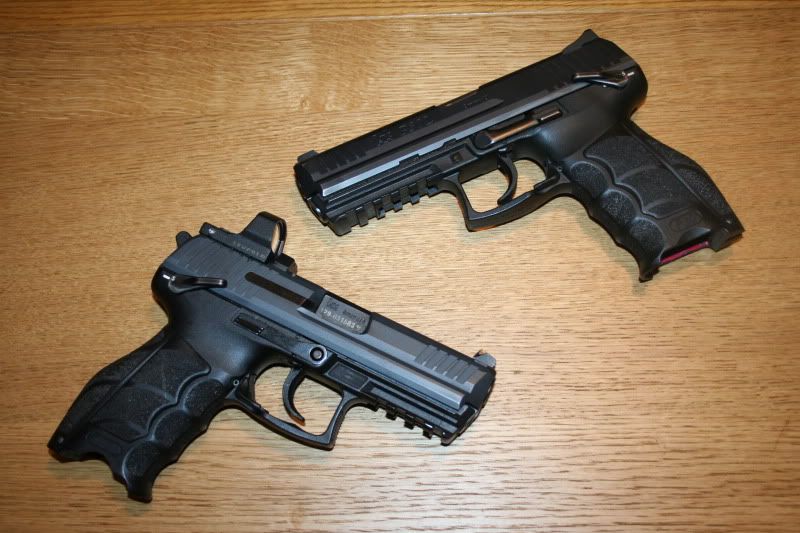 |
| Top: HK P30LS - Light LEM -Bottom HK P30S w/ Leupold Delta Point |
For me it was a great end to the 2012 IDPA season, I went in to 2012 wanting to make Expert, but I planned on doing it in the Custom Defense Pistol (CDP) division, never thought in a million years I'd be doing with a P30LS in LEM in SSP.
As stated, this was our last IDPA match for 2012.
Much thanks goes out to those that helped us at BHPC with successful 2012 IDPA Season.
Back to the drawing board for stages to shoot in 2013!!!
Sunday, November 4, 2012
Bowie HK P30S w/ Delta Point Update
Well we were off to a rough start. The original Delta Point died before I had it fully zeroed it. Leupold replaced it without question.
I installed the replacement unit and set to sighting it in and had some strange trigger issues that I have attributed to the altered slide geometry regarding the firing pin block channel and the "heavy" firing pin block spring. It seems that there was to much tension on the inner workings of the gun and the firing mechanism was binding and the gun would intermittently not go bang. I happened to have a "light" firing pin block spring on hand and tried that as a quick fix and lo and behold my problems went away.
Previously before the original dot died, I had ran the gun in a couple of matches with tape over the emitter and used the back up iron sights. This time I was able to compete with the sight active and I was floored by my level of improvement in almost all areas. The one issue I'm having is picking up the dot during my initial press out for the first shot on target, this just requires more dry practice of mounting the gun and building "muscle memory" ( I hate the term, only because there's always going to be the one guy that says "muscles have memories") in order to replicate proper draw stroke and apply it correctly. In order to do this I need to get the gun a little more up and my head a little more down....
Like Dave Bowie as seen in this picture.

This optic really does wonders with my eye dominance issues by bringing target and sighting into one focal plane*2. So instead of having to look at the target, look at the front sight, look at the rear sight, look at the target etc. I just look at the target and place, in my case the triangle on the target and press the trigger. One little oddity is that to get the optic zeroed, I have the windage almost all the way to the left, I attribute this to my severely dominant left eye.
I have a Glock 17, 2nd Generation on it's way to Bowie for him to work his magic on with some of the same things I had done to the P30. Not sure if I'm going to stick with the Delta Point or go with a Trijicon RMR, Dave currently prefers the Delta Point due to the fact that it keeps zero better than the RMR but the RMR is supposed to be more rugged....Suarez has been doing a lot of work with the RMRs in the last couple of years as well as some others, currently Hilton Yam of 10-8 (their blog is now Modern Service Weapons) has a test going on now with several RMRs and the results are not that impressive but he has been in contact with Trijicon and they are to be improving the RMR to make it more rugged.
Dave has said the same regarding Leupold and the Delta Point and ongoing improvements. Not sure which way I want to go. Good news is that I have some time to think about it as my gun won't be ready till near summer of 2013 so I have some time to evaluate the Delta Point some more before making a decision. Maybe by then we'll see some real progress from either maker, but currently I'm pretty happy with this package.
I installed the replacement unit and set to sighting it in and had some strange trigger issues that I have attributed to the altered slide geometry regarding the firing pin block channel and the "heavy" firing pin block spring. It seems that there was to much tension on the inner workings of the gun and the firing mechanism was binding and the gun would intermittently not go bang. I happened to have a "light" firing pin block spring on hand and tried that as a quick fix and lo and behold my problems went away.
Previously before the original dot died, I had ran the gun in a couple of matches with tape over the emitter and used the back up iron sights. This time I was able to compete with the sight active and I was floored by my level of improvement in almost all areas. The one issue I'm having is picking up the dot during my initial press out for the first shot on target, this just requires more dry practice of mounting the gun and building "muscle memory" ( I hate the term, only because there's always going to be the one guy that says "muscles have memories") in order to replicate proper draw stroke and apply it correctly. In order to do this I need to get the gun a little more up and my head a little more down....
Like Dave Bowie as seen in this picture.
This optic really does wonders with my eye dominance issues by bringing target and sighting into one focal plane*2. So instead of having to look at the target, look at the front sight, look at the rear sight, look at the target etc. I just look at the target and place, in my case the triangle on the target and press the trigger. One little oddity is that to get the optic zeroed, I have the windage almost all the way to the left, I attribute this to my severely dominant left eye.
I have a Glock 17, 2nd Generation on it's way to Bowie for him to work his magic on with some of the same things I had done to the P30. Not sure if I'm going to stick with the Delta Point or go with a Trijicon RMR, Dave currently prefers the Delta Point due to the fact that it keeps zero better than the RMR but the RMR is supposed to be more rugged....Suarez has been doing a lot of work with the RMRs in the last couple of years as well as some others, currently Hilton Yam of 10-8 (their blog is now Modern Service Weapons) has a test going on now with several RMRs and the results are not that impressive but he has been in contact with Trijicon and they are to be improving the RMR to make it more rugged.
I am now on my fourth RMR since starting the project at the end of August. The first three have failed as follows:
- Adjustable intensity RMR07 died after 1185 rounds, with the dot turning on/off intermittently. Thanks to painted witness marks, it was easy to see that the windage adjustment screw was also rotating 2-3 clicks every 50 rounds or so.
- An automatic intensity RMR02 suddenly lost zero after only 625 rounds. The external elevation adjustments had not moved, but the point of impact shifted down about 24″ at 15 yards.
- A second automatic intensity RMR02 (below) lost zero after about 750 rounds in the first day of a class. It was off by about 6″ at 15 yards.
Dave has said the same regarding Leupold and the Delta Point and ongoing improvements. Not sure which way I want to go. Good news is that I have some time to think about it as my gun won't be ready till near summer of 2013 so I have some time to evaluate the Delta Point some more before making a decision. Maybe by then we'll see some real progress from either maker, but currently I'm pretty happy with this package.
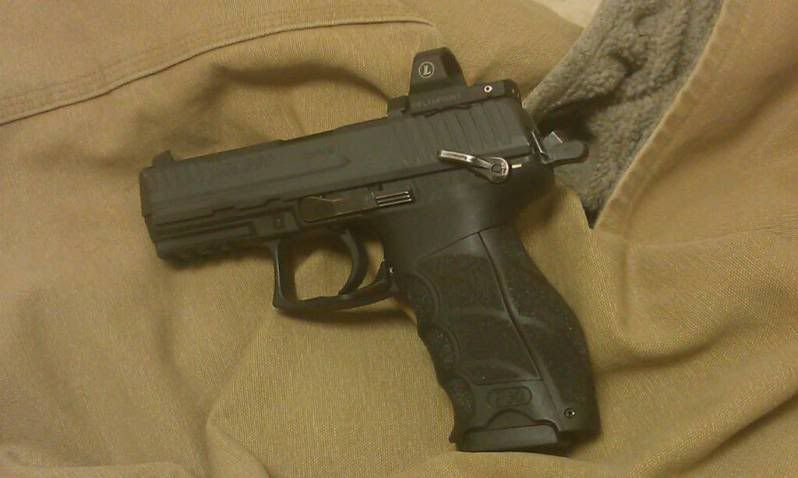 |
| HK P30S with Leupold Delta Point 7.5MOA Triangle Reticle |
Subscribe to:
Posts (Atom)