Showing posts with label Rants and Raves. Show all posts

Monday, March 25, 2013

DiamondBack Police Supply Refuses to Sell Mark Kelly "His" Rifle

From their Facebook page


"Statement of Douglas MacKinlay, Owner/President, Diamondback Police Supply Co., Inc.

“While I support and respect Mark Kelly’s 2nd Amendment rights to purchase, possess, and use firearms in a safe and responsible manner, his recent statements to the media made it clear that his intent in purchasing the Sig Sauer M400 5.56mm rifle from us was for reasons other then for his personal use. In light of this fact, I determined that it was in my company’s best interest to terminate this transaction prior to his returning to my store to complete the Federal From 4473 and NICS background check required of Mr. Kelly before he could take possession this firearm. A full refund was sent to Mr. Kelly, via express mail, on Thursday of last week.
The Sig Sauer rifle will be donated to the Arizona Tactical Officers Association where it will be raffled off to generate funds the association can use to purchase much needed tactical equipment for the organization’s members. The A.T.O. A. represents the SWAT and Special Response officers of the state’s law enforcement community who regularly place their lives on the line to protect the residents of this state.
Additionally, Diamondback Police Supply will make a $1295.00 contribution (the selling price of the M400 rifle) to the Eddie Eagle GunSafe Program that teaches children, in pre-K through 3rd grade, four important steps to take if they find a gun. The emphasis of the program is on child safety, something that is important to all of us and at the core of the current debate on gun control,” stated Douglas MacKinlay, Owner/President, Diamondback Police Supply Co., Inc."

H/T to JD (No relation)  for posting this. Awesome is all I have to say.

Mr. Kelly, excuse my language but would you like a nice cup of STHU with your humble pie?

Saturday, March 9, 2013

But the .22 Has Killed.....

More people than ALL other calibers combined!!!!!!


No, it has not.

This is one of my favorite misunderstandings to to hype, regurgitation, and lack of reading comprehension and maybe just a bit of gun shop know-it-alls.

So we've see this claim, I will use the most recently seen version.

"Some years ago, I ran across a DOJ study that concluded .22LR ammo has killed more people in the USA than any other caliber(s)."

That DOJ study can be found HERE in this 1989 study which states:

"Probably more people in this country have been killed by .22 rimfires than all other calibers combined, which, based on body count, would compel the use of .22’s for self-defense. The more important question, which is sadly seldom asked, is what did the individual do when hit?"

"Probably" does not equal "conclusion."

"Probably" as defined by Websters:
: insofar as seems reasonably true, factual, or to be expected : without much doubt probably
happy> probably rain>
But is the statement above reasonably true? 
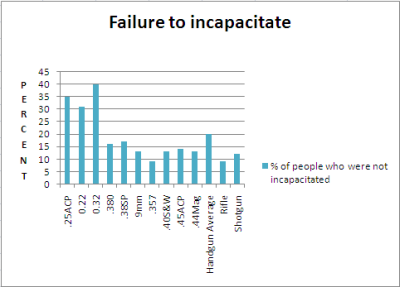
Now granted this is not 1989 and we have some new studies, most recently Greg Ellifritz's An Alternate Look at Handgun Stopping Power  which has some pretty interesting data on the little .22 in that of the handgun calibers, it had the 2nd highest percentage of hits resulting in a fatality and the 3rd lowest rate of incapacitation. 

.22 is third lowest in incapacitation

.22 is 2nd highest (of the handguns) in terms of fatality.
 Seems kind of paradoxical, doesn't it?

I asked Greg about this and he told me pretty much what I expected to hear:

I think the two may be somewhat related...It's a small bullet, it doesn't incapacitate well. I 'm guessing that many of the people who were hit with it (even seriously) didn't know they were hit. They didn't immediately go to the hospital for treatment. By the time they recognized they had a problem, it was too late and they died.
Many of the people shot were criminals. They don't want to go to the hospital with a gunshot wound. They see a little .22 hole in their skin and they say "that ain't shit" as they slowly bleed to death internally.
One other factor to consider is that the .22 is outside lubricated. It picks up all kinds of crap as it goes down the barrel and through clothing. It carries all that crap into the wound. The death rates from infection are likely higher with it than with other bullets.
 Lets look at some other data we have, the original source of this claim comes from 1989, in 1995 we had this paper, Guns Used in Crime which contains these tidbits of info regarding caliber:


  • Surveys of inmates show that they prefer concealable, large caliber guns. Juvenile offenders appear to be more likely to possess guns than adults.
  • Studies of the guns used in homicides show that large caliber revolvers are the most frequent type of gun used in homicides, but the number of large caliber semiautomatic guns used in murders is increasing.

  • Research by Wright and Rossi in the 1980's found that most criminals prefer guns that are easily concealable, large caliber, and well made. Their studies also found that the handguns used by the felons interviewed were similar to the handguns available to the general public, except that the criminals preferred larger caliber guns.

 In this other document, Homicide Trends in the United States 1980-2008 we have the following point to consider:
Data in this report are from the FBI’s Supplementary Homicide Reports (SHR), unless otherwise noted. The SHR Program of the FBI collects yearly supplementary homicide data regarding homicides committed in the
United States. Statistics in this report detail homicide trends by age, sex, and race, including homicides of children under age 5 and of persons age 65 or older. It examines the relationship between the victim and the
offender, particularly in cases of intimate and family homicide. Th e report also examines multiple victim and offender homicides, circumstances surrounding the death, justifiable homicides, law enforcement offi cers
killed, homicides cleared, and homicide trends by city size and weapon use.
 These data may differ slightly from previously published versions because of updates to the data file, changes to the imputation methods used, and refinements in the analyses. (See Methodology for more information on the imputation methods used in this report.) In addition, analyses presented here include data from 1980 through 2008 only. This modification was made, in part, to reflect revisions in the SHR in 1980

 If you look at the FBI's coding of the SHR data you find the following*:

Column 14.
Weapon Used:

Data Element 13 (Type Weapon/Force Involved)—the weapon code numbers are the same for both NIBRS and Summary.  When NIBRS codes 11-15 include a suffix of
A = automatic, disregard the suffix in the conversion process.


11 - Firearm (type not stated)

12 - Handgun

13 - Rifle

14 - Shotgun

15 - Other firearm

20 - Knife/cutting instrument

30 - Blunt object

40 - Personal weapons

50 - Poison

60 - Explosives

65 - Fire/incendiary device

70 - Drugs/narcotics/sleeping pills
 Aside from some other mumbojumbo therein, you won't see any mention of caliber in that report. As such, I would wager that the statement in the report initially quoted has no supporting data.*It is possibly that before 1980 caliber was listed, but I have not yet been able to confirm if it was or was not.

Greg's study is geographically limited, but it stands to reason that the results would average out.

So what does all this mean? I don't think it comes up with anything too concrete other than that when you look at the ratios of what guns are used in crimes, what guns criminals prefer, the fatality stats shown above I think it's on the level to say that while the .22 can certainly kill, it is not "responsible" for more deaths than "all the other calibers" combined, but hey...I could be wrong.

In a pinch I would much rather carry a .22 than nothing, but thankfully I can manage to carry larger.


Saturday, January 5, 2013

Chamber Empty Carry and Perfect Storm Scenarios


In the concealed carry world, we talk about different scenarios where one may find themselves drawing a firearm and defending themselves. Everything from home invasions, robberies, active shooter scenarios, multiple attackers, single attackers, female attackers and everything in between.


There are two distinct types of scenarios that are kind of dangerous to the mental physique of a concealed carrier. Those two are the Kobayashi Maru, AKA the un-winnable scenario (taken from Star Trek 2, the Wrath of Khan) and what I call the "Perfect Storm" scenario.


In the perfect storm scenario, every possible thing goes in favor of the defending party.


A "good" scenario needs to be somewhere in the middle, you should think about and plan for things going wrong and totally not the way that we would "want" it to go. Why? Stuff happens. Sure, the desired outcome is being victorious, but if all you think about is the perfect storm, you don't take into account a lot of variables that can effect a victorious outcome.


We would all like to think that on any given day that we may be called to draw and God forbid use our firearm that we will have crystal clear situational awareness, see the threat approaching from 20 yards away with a red neon sign indicating evil intent, have all the time in the world to sweep a concealment garment out of the way, draw the pistol, step into the text book stance of our liking, and aim in at the target ensuring proper sight alignment, sight picture and start tactical breathing all by the time the threat reaches that magic number of 21' so we can dispense a text-book Mozambique and save the day!


That's probably not the way it's going to happen.


The day that you end up needed to draw your pistol and fight for your life will probably be the day that your dog died, your wife left you for your best friend, you just found out that you're getting fired from your job and your favorite team is not going to the Super Bowl this year.


You're going to have things on your mind, you may see the guy approaching but so what, this day can't get any worse, maybe you even think "Man I wish this guy would try something so I could kick his ass!" and while you're day dreaming, playing THAT scenario out with a grin on your face the dude is now inside your space and straight jacks you in the jaw and THEN you're trying to go for your gun etc.


So where am I going with this? Some of the individuals in the "Carry Community" take these things this into account: what if I don't see it coming, what if I'm injured, what if I'm out numbered, what if.... lack of good lighting, clear threat indicators, etc. We think about things from the worst possible angle, not the best. Lets be honest, if we even have to draw our gun, any hopes of an easy way out of this situation has all ready gone up in smoke and we've just won the lottery of shitty luck, and it's probably not going to get any better.


But if there's one group of people that seem to glance over this it's the "Chamber Empty" or Condition 3 Crowd. Condition Three, or C3 is the weapons condition code for loaded magazine in the firearm, but the chamber is empty requiring manual preparation of the firearm (Most often manually cycling the slide) before the gun can be used.


The most common means of getting the firearm ready for action is to use the support hand to manipulate the slide. That's pretty easy, after all that's pretty much what a lot of people do to load the gun in the first place or it's what many do when facilitating a slide lock or emergency reload.


The main-stay of most C3 carriers regarding this is that "it only takes a second (on a static range, at a non moving target, in optimal conditions) to get the slide moving and chamber a cartridge."


I speculate that many have never tried this with gloves on or in the rain with wet hands, or better yet on their back with their support hand keeping an attacker at bay. Never mind the fact that they are relying on an appendage that may not be available when in need to operate that gun. What if the first indication of an attack is a ball bat striking your support side elbow? What if the threat is pretty close, lets give it the ideal Tueller range of 7 yards and your attacker rushes you and now you're trying to get off the X. When you start rapidly moving your hands tend to travel in opposite directions. You can fumble the loading process by short stroking the slide and now have a JAMMED gun.


If the stats are to be believed, an average gunfight is supposed to be 3yards, 3-5 shots, and be over in 3-5 seconds. Do you want one third of that time (assuming all the ideal conditions have been met) spent trying to get your gun ready to shoot back?


If you are responding with lethal force, you are all ready behind the power curve, you are even further handicapped with a firearm in that is not ready to be fired.


I can understand many that are new to carry or maybe even shooting in general to be....concerned with Condition One (C1-- loaded magazine inserted, cartridge in chamber, firearm on safe (if equipped with one)). For the most part that will wear off with time as training is obtained and the shooter's comfort level increases. But there are some that should know better than to cling to C3 carry as as a "safer" method of carry. Their claim is that there is no possible chance of negligent discharge. While that is true, there's also a lesser chance of an INTENTIONAL discharge.


Provided that proper equipment and gun handling is being used, a firearm carried C1 is just as "safe" as a firearm being carried C3.


Just today I read the following from two members of a gun forum:


Um No. I practice racking with left hand as I get on target. Pretty fast after all these years. No write [right] or wrong here. I just do it the same EVERY time.


AND


Most of the time I don't carry with one in the chamber either, as I posted quite a while ago. Some people don't realize exactly how quickly you can chamber a round if they don't practice it much, if at all. Don't have to worry about ND/AD at all (as long as we treat them like they are loaded every time), if a bg (or even a child) somehow gets your gun it will not fire without racking the slide, no bullet setback. There's a lot more benefits too but I don't have time to list them atm. As long as you practice, it makes no difference how you carry, anyone who thinks otherwise hasn't practiced it enough.


Regarding the first statement, if this chambering process is done the same "every time" how will this process be effected when it CAN'T be done the same way as practiced? What about the possibility of fending off an attacker while drawing a firearm? Lets take the human threat aspect out of this, as much as the concealed carry loves "dog topics," I hate them but lets go there for a second.


What if you're being mauled by that viscous poodle from down the street and your support hand or "weak hand" is now an effective chew toy that managed to keep the dog from latching to your throat? How will you chamber a round then?


Now, I don't put a whole lot of weight into this being something that everyone needs to worry about. There are lots of other possibilities and what ifs and it doesn't take a big imagination to create possible scenarios that would hamper one's ability to defend themselves with an unloaded gun.


I did ask the author of the first statement what he would do should he suffer an injury such as a broken arm, sprained wrist, or shoulder injury and he replied with something along the lines of if aliens removed his arm in his sleep that he would carry with a round in the chamber. Do you really think he's taking carry seriously if he can't even factor in real life injuries? All that time spent doing one way of loading that gun with his support hand is one fall off a ladder, one slip on an icy drive, or one sports injury away from being completely irrelevant.


In the event that the support hand is tied up, many will advocate a rear sight that will facilitate one handed racking of the slide. The idea is not relegated solely to the C3 crowd. It's "tactical" to be able to do this and I will admit that most of my guns have this capability. It's mainly done for malfunction clearing should the support hand be injured, etc. Doing this on the draw can be problematic depending on mode of carry and location. It can add excessive movement to a draw stroke. Remember that 1 second time to chamber a round being 1/3 of a gun fight? That one second grows to 1.5, to 2 seconds pretty quick when the process becomes more complicated. Using the rear sight of a pistol to cycle the slide will depend on a lot of variables going right to do it under stress. That rear sight isn't very large and you need an object or surface to use in conjunction with that rear sight.


Regarding the second, italicized statement, I think that the reason that every single professional instructor out there advocates carrying with a round in the chamber is that they have "practiced" enough to see the huge disadvantages and training gaps associated with carrying a firearm C3 for self defense. I would think that if some TRAINING were added to supplement the "practice" and a little more knowledge be learned about how sudden a situation can develop, fight continuum, getting off the "X" and close quarters defense etc. that attitude might change.


I'm very big on solidarity regarding weapons functionality. I don't want to have a draw stroke process that is different or X, Y, and Z. Getting your gun out of the holster and into play should should be A+B=C, not solve for X.

Friday, September 14, 2012

I really hate it when...

I'm trying to research a gun and all I get are a bunch of nit-wits talking about Call of Duty.


Monday, July 2, 2012

That Darn Poll Again....

Please people, PLEASE let that USA Today poll FROM 2007! die in your in-box. Don't forward it, don't post the link on your favorite gun forum where it's been posted 300 times since SCOTUS was hearing Heller vs. DC...

For those that are unaware of what poll I'm talking about, here's the link...BUT PLEASE, I BEG YOU DO NOT FORWARD THIS LINK TO ANYONE!!!!!


I would be unable to live with myself if I knew that I was enabling this annoying trend to continue.

http://www.usatoday.com/news/quickquestion/2007/november/popup5895.htm


  See guys? It's OK....I think we got this one covered, we've got bigger @%&#^* problems to be worrying about right now.

Wednesday, June 27, 2012

Your Gun is a POS...

That's just the flat out truth.

I don't care what brand or brands you have, someone out there doesn't like it and thinks it's a piece of crap.

Learn to deal with it and don't act like someone kicked your dog when they don't like your gun.

If you come across a gunsmith or an instructor that doesn't like your flavor of Kool-aid, big flopping whoop. It's OK for them to not like your gun, before you get all puffed out and flustered over the affair, it might do you well to ask why they don't like your gun. You might be surprised about what you learn.

Sometimes you may just want to smile and nod, but at other times it may just shed enough light on some unknown issues and make you rethink your choice of firearm.

I don't like Taurus and Kimber

David Bowie doesn't like HKs and Springfield XDs. I have both and one of my HKs is at his place right now pending work and while he may talk smack about my HKs while we're on the line @ TDI, I'm still shooting pretty well with it and it works well for me, despite being "over priced Euro-Trash" and I'm cool with that.

Grant Cunningham doesn't like 1911s, and some people on a 1911 forum about flipped their lid and were amazed that he'd taint his customer base etc.and that they would consider not sending him revolvers for work. That wouldn't stop from from sending him a revolver for tuning (Oh how I wish he was accepting work, I'd send him my Colt Detective Special in a heart beat) what do I care if one of the best revolver smiths around doesn't like 1911s?

Rob Pincus and James Yaeger share his sentiments.

Your gun sucks.

Deal with it.

Thursday, February 9, 2012

The Keith Borders Incident: Why I Love This as a Reference

First and foremost, I regret the taking of any life as I do feel that life is sacred, I feel for the wounded officer for having to take a life, I feel for Mettinger family and all those involved.


But I love this story.  I've referenced this article in two sepearate posts:

An End to the Caliber Debate?
Sometimes "Center of mass" Just Isn't Good Enough...

And I want to take a little more time to address why I find this article so worth hanging onto and discussing any time I can.

It contradicts everything about "average gun fights"

Yes, this is a story about a law enforcement officer, but is it too hard to think of a scenario where this could be you against a felon inside your home with your family that is armed with a shotgun?

From the failure of the .45ACP with six (6) center mass hits (and a severed foot), to the amount of ammo expended, to the fact that a pistol beat a long gun, to the fact that an officer almost had to draw his back up gun, this story smacks down every thing that is erroneously regurgitated by the masses regarding training, prepardness, mindset, and equipment.

"Two shots from a .45 center mass will take a person out of the fight"
WRONG! This guy took 6 hits to the chest and had his foot taken off, AND NO he was not "on drugs"

"But the average gun fight is 3-5 shots"
 TOO BAD! While covering and suppressive fire are seldom found in civilian shootings, it's not a far fetch to admit that it may be required. As gang activity continues to increase and the "issues with Mexico" continue to spill over who knows what some may encounter.

"I don't need to carry a spare mag, let alone two."
THINK AGAIN! This officer was carrying a Glock 21, it has a capacity of 13+1, he almost expended ALL of the ammo for his duty gun and was looking to pull his back up, a revolver holding five (5) cartridges.  He fired 39 times and scored 10 hits, 7 of those hits were to vital areas.

"If the bad guy has a long gun and all you have is a pistol, you're done for" 
NOT IF YOU HAVE THE WILL, AND THE SKILL TO SURVIVE. (a whole lot of luck also goes a long way)

"The basic class I took six years ago was more than enough" 
FIREARMS TRAINING IS NOT A ONE TIME DEAL! 


Firearms Training
Officer Borders credits his firearms training for much of his success. He scored 10 hits out of 39 rounds fired, for a hit ratio of 26 percent, and seven of his hits were to vital areas. Although a 26 percent hit ratio is only about average for a police shooting, Borders' accuracy was far better than his hit ratio seems to indicate. Besides the fact that Mettinger was often more than 20 yards away, never closer than eight yards, and moving or behind good cover for most of the gunfight, Borders also expended a large number of rounds in his successful effort to keep Mettinger from reaching the 00 buckshot stored in the back of the garage. In addition, Borders had to deal with the blood flowing into his eyes, which distracted him, blurred his vision and forced him to pause several times to wipe it away. Under the circumstances, Officer Borders' accuracy was exceptional and that kind of proficiency cannot be achieved without good training.


Did your eight hour NRA Basic Pistol Class prepare you for this? Did the on-line class you took even teach you how to shoot? How long ago was that class? Have you ever drawn from your concealed holster and fired a single shot? Have you ever performed a reload from a magazine carrier on your belt? When the gunsmoke is filling the air and people are screaming, you're not going to have a range bag on a nice tidy bench for your to fish through at your leisure.

Training is paramount.

It is also important to note that Borders is a person who is never content with just being good enough. Rather than settle for the firearms training provided by his department, as good as it was, he trained on his own as often as possible. In addition, he practiced not only his basic shooting skills, but advanced skills as well, like the ricochet shots that served him so well in this case. This is typical of winners. They recognize that police work is a serious business that exposes its practitioners to violent people in desperate situations. Rather than be frightened by that fact, they plan for the day when it may happen by training as hard and as often as possible.

Some key points from the summary of the article:
  • Trust your instincts when you detect potential danger signs, and always put safety first. 
  • Consider carrying a third spare magazine and a backup gun in case you're ever involved in an extended gunfight involving the expenditure of an unusually large number of rounds. Backup guns can also be invaluable in a wide variety of other situations. Every officer should carry one.*
  • Gunshot wounds are seldom fatal. If you are shot, ignore the wound and focus on winning instead.**
  •  Besides developing the skills needed to effectively counter threats, training also instills the self-confidence needed to win. Train often, and train hard. 

*I do not carry three magazines, and have on occasion carried a secondary firearm, at least one spare magazine should be the bare minimum for a "civilian" conealed (or open) carrier. For any LE that may be reading, up your mags to at least three, if your agency allows back up guns (BUGs), carry one of thsoe as well.

**This works both ways, both Mettinger and Borders were hit and continued to stay in the fight. Do not expect one, two, or even three rounds to stop an attacker. I'd rather be surprised after the fact that it only took two or three than standing there in bewilderment that two didn't do the job.


In closing, "The Average Gun Fight Is..." If you're in a gun fight, the law of averages is all ready against you. The argument of the average gun fight being 7 yards or less, 3-5 shots and over in 3-5 seconds is just that, average. If you want your capabilities to be "average", you're not looking at this self defense thing the right way. Do you really want to be prepard for the "average" situation when defending your life, or do you want to be prepared for an above average situation?

Saturday, February 4, 2012

Sometimes "Center of mass" Just Isn't Good Enough...

There's a discussion going on about XS sights, and while that topic can get kind of laborious, what I am finding interesting in this debate is that a lot of people are just regurgitating the "center mass" chant.

Well guess what, sometimes center mass just isn't good enough.

Mettinger absorbed nine rounds from Borders' .45—six of which hit him in the torso and two more of which literally severed his right foot—without any significant effect on his fighting ability. This would have been remarkable even if Officer Borders had been firing marginally effective rounds, but he was using .45 caliber Gold Dot ammunition, which is considered by many to be the best man-stopper on the market.
...
He stopped next to his cruiser's back fender, squatted there briefly as he took another deep breath and then brought the gun up to fire. His vision narrowed until he could see nothing but Mettinger's anger-laden face and his sights resting on the bridge of the man's nose. He fired, sending the big .45 caliber slug through Mettinger's left eye and deep into his brain, dropping him instantly.

Sometimes, you might just have to aim...