The first thing that the researchers learned is that our assumptions about criminals not training are wrong. Nearly 40% of the criminal attackers in this study had received FORMAL firearms training (mostly in the military). More than 80% of the criminal attackers regularly practiced with their firearms, with an average number of 23 Practice Sessions Per Year! They conducted these practice sessions in trash dumps, wooded areas, back yards and “street corners in known drug trafficking areas”. What that means is that the practice sessions were taking place in realistic environments, under conditions similar to those the attackers were likely to face in combat
Showing posts with label Self Defense. Show all posts
Showing posts with label Self Defense. Show all posts
Tuesday, December 10, 2013
How Skilled is Your Attacker?
An interesting read here:


Friday, October 11, 2013
AAR: Tactical Defense Institute's Extreme Close Quarters (ECQ) 10/5-6/2013
The first sign that you might be in trouble is coming to and finding someone on top of you reeling back to start beating the snot out of you. I know it's cliché' and everyone will tell you that you're being paranoid or that just having a gun is enough etc. but there is a very big risk as a concealed carrier or person who goes about armed on a regular basis. If you're an open carrier, be it as a Law Enforcement Officer or armed civilian, even more so. And that risk is that your gun can be used against you.
If you look at FBI stats on lost gun fights (why they don't put more emphasis on victories is beyond me) you will see that a lot of dead officers ended up that way while in close proximity to their attacker, a lot of times it's with their own pistol. I've covered these numbers in brief before, but here they are again.

To make a long story short, there's a lot that can happen in close distances that can put you behind the eight ball. A flubbed draw, a snagged cover garment, a lapse in situational awareness (contrary to popular belief you can't maintain 100% situational awareness and keep every one out past a 21' radius of your position) and just bad luck can result in an attacker being right up on you before you know it.
A lot of us train in the proper use of firearms. A lot of time is spent on drawing the gun, aiming the gun, firing the gun, reloading the gun etc. Not a lot of time is spent learning to draw a gun while someone is actively beating you. Not a lot of time is spent learning how to keep the gun away from someone that is actively beating you, and not a lot of time is spent on learning how to keep your gun running while actively defending yourself against someone...you got it...that is actively beating on you.
A lot of us that carry firearms are also "gun centric" we have a gun so we don't learn how to fight, we have a gun so we don't carry a knife, we have a gun so we can shoot our way out of trouble.
But what happens when you can't shoot your way out of trouble? The gun is not always the best answer and in wanting to be well rounded I found ourselves at the Tactical Defense Institute (TDI) in Ohio attending their Extreme Close Quarters Class. If you've been reading this blog for a time you may have read our other reviews of TDI classes, if not you can find them HERE, as such we are not strangers to TDI and we've always been pleased with the training we've received there.
The Extreme Close Quarters (ECQ) class is typically offered once a year and it fills up fast so if you want to attend you need to sign up fast. Their Handgun III or Equivalent is required.
One of the things I like most about TDI is the instructor/student ratio. I want to say we had a class of nineteen and seven instructors. While the other students acted as safety persons, you won't find much of the "coach - pupil" method in place @ TDI. Sure the other students are helpful if they spot you doing something wonky but there's plenty of instructors walking the training area looking to help and instruct. It's also nice to get several different sets of eyes looking over your techniques.
The lead instructors were Greg Ellifritz and David Bowie.
In the class we covered some of the distance stats that I referenced above as well as the following:
:What is required to get your gun out while in a physical altercation.
: What constitutes a good retention position.
: Expected operation of your pistol in close proximity to your target.
: Clearing of cover garments
: Live Fire - "TDI Retention" and transitions from/to retention and extended - Moving Forward
: Stuffing the draw of an aggressor
: Countering a stuffed draw
: Fighting an armed attacker
: Issues with handgun mechanics in close quarters
: Live Fire - "TDI Retention" and transitions from/to retention and extended - Moving Rearward
Now I'm not going to go into too much detail, if you want all the details do what I did and go take the class. But I will go into a little detail about some of what we learned, what I all ready knew that was reinforced, and just some thoughts on the class.
Getting your gun out. In a perfect world we'll always see trouble coming three miles away. The world is not perfect. A good holster and a concealment garment (if applicable) need to work together and you need to practice getting at your gun from a variety of positions, and not just standing. Can you get it with one hand? Can you get it on the ground? Can you get it on your back with someone sitting on you raining down blows?
Retention. There's a variety of different retention positions. Some are better than others and some of the lesser methods leave the gun too far out or "Floating" keep the gun in for the best protection.
We should all be aware that semi-autos can be forced out of battery and can be fickle things when filled up with gunk. Gunk as in someone skin clogging the ejection port after you fire a close shot. Can you clear malfunctions? Can you clear malfunctions one handed? Can you clear malfunctions one handed while going fisticuffs with your attacker either defending your dome or attacking theirs? Yeah, we covered that and there's some good tactics and things to think about. Is your gun set up to easily facilitate one handed cycling on a belt or other surface?
I all ready talked a little about cover garments, but to reiterate, YOU NEED TO BE ABLE TO GET YOUR GUN OUT! If you're carrying under a closed front shirt, you need to lift that shirt HIGH.
Stuffing / Countering a Stuffed Draw. We discussed techniques to counter an attacker trying to stuff your draw and how to stuff your attackers draw. We also spent some time using empty hand techniques against armed attackers to negate their weapon. This is one of those things that you'll have to just go the class to learn.
Handguns, even revolvers are easy to tie up in close quarters. Slides can be pushed back, revolver cylinder can be bound up. They taught some nice tricks to keep your gun running including one in which while running a revolver you can use your attacker to rotate the cylinder. That was pretty cool.
Another thing that we saw was that depending on wrist angle, you might not even be able to pull a heavy trigger, like that of a traditional double action semi-automatic.
Creating distance is a two edged sword. You can get distance to get your gun out, but that also gives your attacker distance to do the same or access another weapon. If they've got a hand on your gun, you can't just shove them off as the gun might go with them and leave you reaching for an empty holster. We learned ways to create enough distance to access a firearm and use it.
Empty hand to armed transitions. There may be a time where something starts as a situation that you think you can handle with empty hands and escalates to a situation where you need some help. This kind of ties in with creating distance but it all boils down to creating an opportunity where you can access your gun and draw it without it being blocked.
Weapon retention. It's amazing how ingrained fully extending the pistol is now. I think a lot of us have spent so much time pressing the gun out that it's what we want to do even when it's in our best interest to keep it in a retention position. When I was still on active duty in the Marines the Marine Corps Martial Arts Program (MCMAP) was being phased in. A common sound-byte was "An extended limb is a broken limb" in close quarters gun fighting, an extended gun is going to be grabbed, snatched, and otherwise wrenched on. Keep it close to the body.
Holster selection. They covered good holster and bad holsters. Cheap paddles: BAD. Serpas: BAD. Fobus: BAD. 5.11 Thumb-Drive: BAD. "Slide holsters" that don't cover the entire slide of the gun: BAD. To elaborate on the slide holsters, pending on your position and while rolling around it's easy for pressure on the bottom of the gun to force it out of the holster. A holster should cover the muzzle.
The Safariland ALS got high marks.
Knife work. We did a very brief portion on knives, for a review of TDI's Defensive Knife Class you can read it HERE. This class really reinforced using the support side fixed blade in a lot of cases. I picked up a couple more TDI knives. Again, this was really brief and was kind of a primer for the Defensive Knife Class but it was a good primer and gave the students something to think about.
Ground defense. There's only so much time to spend on this in a two day class, it take a lot of time to get "good" at unarmed combat and defense. They taught a couple of basic techniques to help you out in a ground fight. The wife and I have been studying with a Krav Maga instructor for the last year and it's really starting to pay off. Go out and start learning to improve your empty hand skills. They can be your first and last line of defense and unlike a gun will always be with you.
The live fire work was pretty light, the class info on TDI's website says 600 rounds, we probably shot less then 400rds between the two of us, but still bring the required 600 as it may have been abbreviated due to the still lurking ammo shortage. We did some shooting on the ground which was pretty neat. I've done a good amount of that in the past, but it was nice to get a refresher. We also shot from chest ready on paper and steel, that was a nice eye opener for some of the students to see what they were capable of with no sights and just indexing on the target.
We worked live fire drills shooting from retention and working from retention to extended and the other way around. Movement was pretty basic, just forward and rear. This is not a moving and shooting course. I would have liked to see more lateral or oblique movement.
Force on Force. Near the end of day two we did two force on force scenarios. These are optional but encouraged. We started with a stand up scenario with your typical "interview process" and you had to play it out. The students act as a jury of sorts and we debrief after the scenario to determine if the actions were justifiable.
The 2nd scenario started under the premise that you were knocked unconscious and come to with your attacker in the mount.
Both scenarios were pretty interesting and the beauty of it is that no two are the same.
Do keep in mind that this is a training environment and while the instructors are pretty well protected the students are not. This is not full contact training and was really pretty moderate. It's a two day class and not all students walk in the door with empty hand skills. This just acts as a more fluid experience in working the techniques that are being taught in the class. It's not meant to be as realistic as possible or a substitute for an actual steady training regimen in empty hand combatives.
Overall I really, really enjoyed the class. It really enforced the need for some empty hand skills, the off-side carry of a fixed blade and really knowing how to run your gun in a variety of environments.
The gear I used for the class was my 2nd Gen Glock 17(slightly modified), a Fricke Seraphim AIWB holster, and a single Blackhawk CQC mag carrier. I kept a couple spare mags in a pocket and more in the range bag ready to go but this was not a heavy round count class so we didn't need a lot of mags on your person. I did the first day not working from concealment and concealed the second day of class.
My gun functioned well, while some students had malfunctions a lot of it was a result of poor retention positions and odd grips while firing.
This was my first time working live fire from AIWB and I'm pleased to say I didn't blow my junk off or otherwise shoot myself. The advantages of AIWB while trying to control a holstered pistol are pretty impressive. Having the gun centered really allows you to keep pressure on it and it's just all around easier to defend and access.
If you look at FBI stats on lost gun fights (why they don't put more emphasis on victories is beyond me) you will see that a lot of dead officers ended up that way while in close proximity to their attacker, a lot of times it's with their own pistol. I've covered these numbers in brief before, but here they are again.
To make a long story short, there's a lot that can happen in close distances that can put you behind the eight ball. A flubbed draw, a snagged cover garment, a lapse in situational awareness (contrary to popular belief you can't maintain 100% situational awareness and keep every one out past a 21' radius of your position) and just bad luck can result in an attacker being right up on you before you know it.
A lot of us train in the proper use of firearms. A lot of time is spent on drawing the gun, aiming the gun, firing the gun, reloading the gun etc. Not a lot of time is spent learning to draw a gun while someone is actively beating you. Not a lot of time is spent learning how to keep the gun away from someone that is actively beating you, and not a lot of time is spent on learning how to keep your gun running while actively defending yourself against someone...you got it...that is actively beating on you.
A lot of us that carry firearms are also "gun centric" we have a gun so we don't learn how to fight, we have a gun so we don't carry a knife, we have a gun so we can shoot our way out of trouble.
But what happens when you can't shoot your way out of trouble? The gun is not always the best answer and in wanting to be well rounded I found ourselves at the Tactical Defense Institute (TDI) in Ohio attending their Extreme Close Quarters Class. If you've been reading this blog for a time you may have read our other reviews of TDI classes, if not you can find them HERE, as such we are not strangers to TDI and we've always been pleased with the training we've received there.
The Extreme Close Quarters (ECQ) class is typically offered once a year and it fills up fast so if you want to attend you need to sign up fast. Their Handgun III or Equivalent is required.
We believe this unusual, innovative class to be the first of its kind ever offered. No one weapon is the sole answer. You may well have to engage with your hands prior to deploying another weapon. ECQ integrates the use of the hands, knives and handguns in the extreme close quarter’s environment.Learn weapon retention and takeaway, physical interaction with hands and other weapons. Deal with single and multiple assailants. Learn to protect your partner/family member in the ECQ environment. This class is not for the faint at heart and a must for law enforcement professionals and citizens alike.Prerequisites: Level III handgun or equivalent.This class covered a LOT of material, this could easily be a three day class but they do a pretty good job in the span of two days.
One of the things I like most about TDI is the instructor/student ratio. I want to say we had a class of nineteen and seven instructors. While the other students acted as safety persons, you won't find much of the "coach - pupil" method in place @ TDI. Sure the other students are helpful if they spot you doing something wonky but there's plenty of instructors walking the training area looking to help and instruct. It's also nice to get several different sets of eyes looking over your techniques.
The lead instructors were Greg Ellifritz and David Bowie.
In the class we covered some of the distance stats that I referenced above as well as the following:
:What is required to get your gun out while in a physical altercation.
: What constitutes a good retention position.
: Expected operation of your pistol in close proximity to your target.
: Clearing of cover garments
: Live Fire - "TDI Retention" and transitions from/to retention and extended - Moving Forward
: Stuffing the draw of an aggressor
: Countering a stuffed draw
: Fighting an armed attacker
: Issues with handgun mechanics in close quarters
: Live Fire - "TDI Retention" and transitions from/to retention and extended - Moving Rearward
: Creating Distance
:Transitioning from empty handed defense to armed defense
: Weapon retention
: Holster selection
: Knife work
: Ground defense
: Live Fire - Shooting from the ground.
: Force on Force Scenarios - Stand up and starting on the ground.
: Force on Force Scenarios - Stand up and starting on the ground.
Now I'm not going to go into too much detail, if you want all the details do what I did and go take the class. But I will go into a little detail about some of what we learned, what I all ready knew that was reinforced, and just some thoughts on the class.
Getting your gun out. In a perfect world we'll always see trouble coming three miles away. The world is not perfect. A good holster and a concealment garment (if applicable) need to work together and you need to practice getting at your gun from a variety of positions, and not just standing. Can you get it with one hand? Can you get it on the ground? Can you get it on your back with someone sitting on you raining down blows?
Retention. There's a variety of different retention positions. Some are better than others and some of the lesser methods leave the gun too far out or "Floating" keep the gun in for the best protection.
We should all be aware that semi-autos can be forced out of battery and can be fickle things when filled up with gunk. Gunk as in someone skin clogging the ejection port after you fire a close shot. Can you clear malfunctions? Can you clear malfunctions one handed? Can you clear malfunctions one handed while going fisticuffs with your attacker either defending your dome or attacking theirs? Yeah, we covered that and there's some good tactics and things to think about. Is your gun set up to easily facilitate one handed cycling on a belt or other surface?
I all ready talked a little about cover garments, but to reiterate, YOU NEED TO BE ABLE TO GET YOUR GUN OUT! If you're carrying under a closed front shirt, you need to lift that shirt HIGH.
Stuffing / Countering a Stuffed Draw. We discussed techniques to counter an attacker trying to stuff your draw and how to stuff your attackers draw. We also spent some time using empty hand techniques against armed attackers to negate their weapon. This is one of those things that you'll have to just go the class to learn.
Handguns, even revolvers are easy to tie up in close quarters. Slides can be pushed back, revolver cylinder can be bound up. They taught some nice tricks to keep your gun running including one in which while running a revolver you can use your attacker to rotate the cylinder. That was pretty cool.
Another thing that we saw was that depending on wrist angle, you might not even be able to pull a heavy trigger, like that of a traditional double action semi-automatic.
Creating distance is a two edged sword. You can get distance to get your gun out, but that also gives your attacker distance to do the same or access another weapon. If they've got a hand on your gun, you can't just shove them off as the gun might go with them and leave you reaching for an empty holster. We learned ways to create enough distance to access a firearm and use it.
Empty hand to armed transitions. There may be a time where something starts as a situation that you think you can handle with empty hands and escalates to a situation where you need some help. This kind of ties in with creating distance but it all boils down to creating an opportunity where you can access your gun and draw it without it being blocked.
Weapon retention. It's amazing how ingrained fully extending the pistol is now. I think a lot of us have spent so much time pressing the gun out that it's what we want to do even when it's in our best interest to keep it in a retention position. When I was still on active duty in the Marines the Marine Corps Martial Arts Program (MCMAP) was being phased in. A common sound-byte was "An extended limb is a broken limb" in close quarters gun fighting, an extended gun is going to be grabbed, snatched, and otherwise wrenched on. Keep it close to the body.
Holster selection. They covered good holster and bad holsters. Cheap paddles: BAD. Serpas: BAD. Fobus: BAD. 5.11 Thumb-Drive: BAD. "Slide holsters" that don't cover the entire slide of the gun: BAD. To elaborate on the slide holsters, pending on your position and while rolling around it's easy for pressure on the bottom of the gun to force it out of the holster. A holster should cover the muzzle.
The Safariland ALS got high marks.
Knife work. We did a very brief portion on knives, for a review of TDI's Defensive Knife Class you can read it HERE. This class really reinforced using the support side fixed blade in a lot of cases. I picked up a couple more TDI knives. Again, this was really brief and was kind of a primer for the Defensive Knife Class but it was a good primer and gave the students something to think about.
Ground defense. There's only so much time to spend on this in a two day class, it take a lot of time to get "good" at unarmed combat and defense. They taught a couple of basic techniques to help you out in a ground fight. The wife and I have been studying with a Krav Maga instructor for the last year and it's really starting to pay off. Go out and start learning to improve your empty hand skills. They can be your first and last line of defense and unlike a gun will always be with you.
The live fire work was pretty light, the class info on TDI's website says 600 rounds, we probably shot less then 400rds between the two of us, but still bring the required 600 as it may have been abbreviated due to the still lurking ammo shortage. We did some shooting on the ground which was pretty neat. I've done a good amount of that in the past, but it was nice to get a refresher. We also shot from chest ready on paper and steel, that was a nice eye opener for some of the students to see what they were capable of with no sights and just indexing on the target.
We worked live fire drills shooting from retention and working from retention to extended and the other way around. Movement was pretty basic, just forward and rear. This is not a moving and shooting course. I would have liked to see more lateral or oblique movement.
Force on Force. Near the end of day two we did two force on force scenarios. These are optional but encouraged. We started with a stand up scenario with your typical "interview process" and you had to play it out. The students act as a jury of sorts and we debrief after the scenario to determine if the actions were justifiable.
The 2nd scenario started under the premise that you were knocked unconscious and come to with your attacker in the mount.
Both scenarios were pretty interesting and the beauty of it is that no two are the same.
Do keep in mind that this is a training environment and while the instructors are pretty well protected the students are not. This is not full contact training and was really pretty moderate. It's a two day class and not all students walk in the door with empty hand skills. This just acts as a more fluid experience in working the techniques that are being taught in the class. It's not meant to be as realistic as possible or a substitute for an actual steady training regimen in empty hand combatives.
Overall I really, really enjoyed the class. It really enforced the need for some empty hand skills, the off-side carry of a fixed blade and really knowing how to run your gun in a variety of environments.
The gear I used for the class was my 2nd Gen Glock 17(slightly modified), a Fricke Seraphim AIWB holster, and a single Blackhawk CQC mag carrier. I kept a couple spare mags in a pocket and more in the range bag ready to go but this was not a heavy round count class so we didn't need a lot of mags on your person. I did the first day not working from concealment and concealed the second day of class.
My gun functioned well, while some students had malfunctions a lot of it was a result of poor retention positions and odd grips while firing.
This was my first time working live fire from AIWB and I'm pleased to say I didn't blow my junk off or otherwise shoot myself. The advantages of AIWB while trying to control a holstered pistol are pretty impressive. Having the gun centered really allows you to keep pressure on it and it's just all around easier to defend and access.
Saturday, March 9, 2013
But the .22 Has Killed.....
More people than ALL other calibers combined!!!!!!
No, it has not.
This is one of my favorite misunderstandings to to hype, regurgitation, and lack of reading comprehension and maybe just a bit of gun shop know-it-alls.
So we've see this claim, I will use the most recently seen version.
That DOJ study can be found HERE in this 1989 study which states:
"Probably" does not equal "conclusion."
"Probably" as defined by Websters:
happy> probably rain>
No, it has not.
This is one of my favorite misunderstandings to to hype, regurgitation, and lack of reading comprehension and maybe just a bit of gun shop know-it-alls.
So we've see this claim, I will use the most recently seen version.
That DOJ study can be found HERE in this 1989 study which states:
"Probably more people in this country have been killed by .22 rimfires than all other calibers combined, which, based on body count, would compel the use of .22’s for self-defense. The more important question, which is sadly seldom asked, is what did the individual do when hit?"
"Probably" does not equal "conclusion."
"Probably" as defined by Websters:
: insofar as seems reasonably true, factual, or to be expected : without much doubt probably
But is the statement above reasonably true?
Now granted this is not 1989 and we have some new studies, most recently Greg Ellifritz's An Alternate Look at Handgun Stopping Power which has some pretty interesting data on the little .22 in that of the handgun calibers, it had the 2nd highest percentage of hits resulting in a fatality and the 3rd lowest rate of incapacitation.
Seems kind of paradoxical, doesn't it?
I asked Greg about this and he told me pretty much what I expected to hear:

If you look at the FBI's coding of the SHR data you find the following*:
In a pinch I would much rather carry a .22 than nothing, but thankfully I can manage to carry larger.
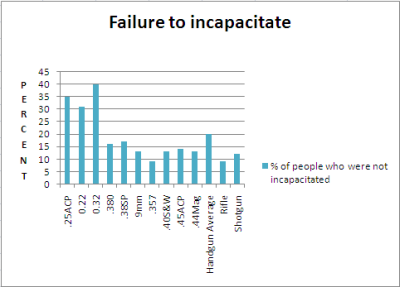 | ||
| .22 is third lowest in incapacitation |
 |
| .22 is 2nd highest (of the handguns) in terms of fatality. |
I asked Greg about this and he told me pretty much what I expected to hear:
I think the two may be somewhat related...It's a small bullet, it doesn't incapacitate well. I 'm guessing that many of the people who were hit with it (even seriously) didn't know they were hit. They didn't immediately go to the hospital for treatment. By the time they recognized they had a problem, it was too late and they died.Lets look at some other data we have, the original source of this claim comes from 1989, in 1995 we had this paper, Guns Used in Crime which contains these tidbits of info regarding caliber:
Many of the people shot were criminals. They don't want to go to the hospital with a gunshot wound. They see a little .22 hole in their skin and they say "that ain't shit" as they slowly bleed to death internally.
One other factor to consider is that the .22 is outside lubricated. It picks up all kinds of crap as it goes down the barrel and through clothing. It carries all that crap into the wound. The death rates from infection are likely higher with it than with other bullets.
- Surveys of inmates show that they prefer concealable, large caliber guns. Juvenile offenders appear to be more likely to possess guns than adults.
- Studies of the guns used in homicides show that large caliber revolvers are the most frequent type of gun used in homicides, but the number of large caliber semiautomatic guns used in murders is increasing.
- Research by Wright and Rossi in the 1980's found that most criminals prefer guns that are easily concealable, large caliber, and well made. Their studies also found that the handguns used by the felons interviewed were similar to the handguns available to the general public, except that the criminals preferred larger caliber guns.

In this other document, Homicide Trends in the United States 1980-2008 we have the following point to consider:
Data in this report are from the FBI’s Supplementary Homicide Reports (SHR), unless otherwise noted. The SHR Program of the FBI collects yearly supplementary homicide data regarding homicides committed in theUnited States. Statistics in this report detail homicide trends by age, sex, and race, including homicides of children under age 5 and of persons age 65 or older. It examines the relationship between the victim and theoffender, particularly in cases of intimate and family homicide. Th e report also examines multiple victim and offender homicides, circumstances surrounding the death, justifiable homicides, law enforcement offi cerskilled, homicides cleared, and homicide trends by city size and weapon use.
These data may differ slightly from previously published versions because of updates to the data file, changes to the imputation methods used, and refinements in the analyses. (See Methodology for more information on the imputation methods used in this report.) In addition, analyses presented here include data from 1980 through 2008 only. This modification was made, in part, to reflect revisions in the SHR in 1980
If you look at the FBI's coding of the SHR data you find the following*:
Aside from some other mumbojumbo therein, you won't see any mention of caliber in that report. As such, I would wager that the statement in the report initially quoted has no supporting data.*It is possibly that before 1980 caliber was listed, but I have not yet been able to confirm if it was or was not.
Greg's study is geographically limited, but it stands to reason that the results would average out.
So what does all this mean? I don't think it comes up with anything too concrete other than that when you look at the ratios of what guns are used in crimes, what guns criminals prefer, the fatality stats shown above I think it's on the level to say that while the .22 can certainly kill, it is not "responsible" for more deaths than "all the other calibers" combined, but hey...I could be wrong.In a pinch I would much rather carry a .22 than nothing, but thankfully I can manage to carry larger.
Saturday, January 5, 2013
Chamber Empty Carry and Perfect Storm Scenarios
In the concealed carry world, we talk about different scenarios where one may find themselves drawing a firearm and defending themselves. Everything from home invasions, robberies, active shooter scenarios, multiple attackers, single attackers, female attackers and everything in between.
There are two distinct types of scenarios that are kind of dangerous to the mental physique of a concealed carrier. Those two are the Kobayashi Maru, AKA the un-winnable scenario (taken from Star Trek 2, the Wrath of Khan) and what I call the "Perfect Storm" scenario.
In the perfect storm scenario, every possible thing goes in favor of the defending party.
A "good" scenario needs to be somewhere in the middle, you should think about and plan for things going wrong and totally not the way that we would "want" it to go. Why? Stuff happens. Sure, the desired outcome is being victorious, but if all you think about is the perfect storm, you don't take into account a lot of variables that can effect a victorious outcome.
We would all like to think that on any given day that we may be called to draw and God forbid use our firearm that we will have crystal clear situational awareness, see the threat approaching from 20 yards away with a red neon sign indicating evil intent, have all the time in the world to sweep a concealment garment out of the way, draw the pistol, step into the text book stance of our liking, and aim in at the target ensuring proper sight alignment, sight picture and start tactical breathing all by the time the threat reaches that magic number of 21' so we can dispense a text-book Mozambique and save the day!
That's probably not the way it's going to happen.
The day that you end up needed to draw your pistol and fight for your life will probably be the day that your dog died, your wife left you for your best friend, you just found out that you're getting fired from your job and your favorite team is not going to the Super Bowl this year.
You're going to have things on your mind, you may see the guy approaching but so what, this day can't get any worse, maybe you even think "Man I wish this guy would try something so I could kick his ass!" and while you're day dreaming, playing THAT scenario out with a grin on your face the dude is now inside your space and straight jacks you in the jaw and THEN you're trying to go for your gun etc.
So where am I going with this? Some of the individuals in the "Carry Community" take these things this into account: what if I don't see it coming, what if I'm injured, what if I'm out numbered, what if.... lack of good lighting, clear threat indicators, etc. We think about things from the worst possible angle, not the best. Lets be honest, if we even have to draw our gun, any hopes of an easy way out of this situation has all ready gone up in smoke and we've just won the lottery of shitty luck, and it's probably not going to get any better.
But if there's one group of people that seem to glance over this it's the "Chamber Empty" or Condition 3 Crowd. Condition Three, or C3 is the weapons condition code for loaded magazine in the firearm, but the chamber is empty requiring manual preparation of the firearm (Most often manually cycling the slide) before the gun can be used.
The most common means of getting the firearm ready for action is to use the support hand to manipulate the slide. That's pretty easy, after all that's pretty much what a lot of people do to load the gun in the first place or it's what many do when facilitating a slide lock or emergency reload.
The main-stay of most C3 carriers regarding this is that "it only takes a second (on a static range, at a non moving target, in optimal conditions) to get the slide moving and chamber a cartridge."
I speculate that many have never tried this with gloves on or in the rain with wet hands, or better yet on their back with their support hand keeping an attacker at bay. Never mind the fact that they are relying on an appendage that may not be available when in need to operate that gun. What if the first indication of an attack is a ball bat striking your support side elbow? What if the threat is pretty close, lets give it the ideal Tueller range of 7 yards and your attacker rushes you and now you're trying to get off the X. When you start rapidly moving your hands tend to travel in opposite directions. You can fumble the loading process by short stroking the slide and now have a JAMMED gun.
If the stats are to be believed, an average gunfight is supposed to be 3yards, 3-5 shots, and be over in 3-5 seconds. Do you want one third of that time (assuming all the ideal conditions have been met) spent trying to get your gun ready to shoot back?
If you are responding with lethal force, you are all ready behind the power curve, you are even further handicapped with a firearm in that is not ready to be fired.
I can understand many that are new to carry or maybe even shooting in general to be....concerned with Condition One (C1-- loaded magazine inserted, cartridge in chamber, firearm on safe (if equipped with one)). For the most part that will wear off with time as training is obtained and the shooter's comfort level increases. But there are some that should know better than to cling to C3 carry as as a "safer" method of carry. Their claim is that there is no possible chance of negligent discharge. While that is true, there's also a lesser chance of an INTENTIONAL discharge.
Provided that proper equipment and gun handling is being used, a firearm carried C1 is just as "safe" as a firearm being carried C3.
Just today I read the following from two members of a gun forum:
Um No. I practice racking with left hand as I get on target. Pretty fast after all these years. No write [right] or wrong here. I just do it the same EVERY time.
AND
Most of the time I don't carry with one in the chamber either, as I posted quite a while ago. Some people don't realize exactly how quickly you can chamber a round if they don't practice it much, if at all. Don't have to worry about ND/AD at all (as long as we treat them like they are loaded every time), if a bg (or even a child) somehow gets your gun it will not fire without racking the slide, no bullet setback. There's a lot more benefits too but I don't have time to list them atm. As long as you practice, it makes no difference how you carry, anyone who thinks otherwise hasn't practiced it enough.
Regarding the first statement, if this chambering process is done the same "every time" how will this process be effected when it CAN'T be done the same way as practiced? What about the possibility of fending off an attacker while drawing a firearm? Lets take the human threat aspect out of this, as much as the concealed carry loves "dog topics," I hate them but lets go there for a second.
What if you're being mauled by that viscous poodle from down the street and your support hand or "weak hand" is now an effective chew toy that managed to keep the dog from latching to your throat? How will you chamber a round then?
Now, I don't put a whole lot of weight into this being something that everyone needs to worry about. There are lots of other possibilities and what ifs and it doesn't take a big imagination to create possible scenarios that would hamper one's ability to defend themselves with an unloaded gun.
I did ask the author of the first statement what he would do should he suffer an injury such as a broken arm, sprained wrist, or shoulder injury and he replied with something along the lines of if aliens removed his arm in his sleep that he would carry with a round in the chamber. Do you really think he's taking carry seriously if he can't even factor in real life injuries? All that time spent doing one way of loading that gun with his support hand is one fall off a ladder, one slip on an icy drive, or one sports injury away from being completely irrelevant.
In the event that the support hand is tied up, many will advocate a rear sight that will facilitate one handed racking of the slide. The idea is not relegated solely to the C3 crowd. It's "tactical" to be able to do this and I will admit that most of my guns have this capability. It's mainly done for malfunction clearing should the support hand be injured, etc. Doing this on the draw can be problematic depending on mode of carry and location. It can add excessive movement to a draw stroke. Remember that 1 second time to chamber a round being 1/3 of a gun fight? That one second grows to 1.5, to 2 seconds pretty quick when the process becomes more complicated. Using the rear sight of a pistol to cycle the slide will depend on a lot of variables going right to do it under stress. That rear sight isn't very large and you need an object or surface to use in conjunction with that rear sight.
Regarding the second, italicized statement, I think that the reason that every single professional instructor out there advocates carrying with a round in the chamber is that they have "practiced" enough to see the huge disadvantages and training gaps associated with carrying a firearm C3 for self defense. I would think that if some TRAINING were added to supplement the "practice" and a little more knowledge be learned about how sudden a situation can develop, fight continuum, getting off the "X" and close quarters defense etc. that attitude might change.
I'm very big on solidarity regarding weapons functionality. I don't want to have a draw stroke process that is different or X, Y, and Z. Getting your gun out of the holster and into play should should be A+B=C, not solve for X.
Thursday, May 3, 2012
Pearls of Wisdom From The Greatest Generation Part 1
Pearls of Wisdom From The Greatest Generation Part 1
-Select quotes from “Shooting to Live” –
Fairbairn and Sykes
-Select quotes from “Shooting to Live” –
Fairbairn and Sykes
I am utterly amazed that I have not read this piece before now, I’ve seen it mentioned many times over, have seen it available when shopping for other books but have never pulled the trigger on it so to speak until know. The following is just a list of quotes from the book that jumped out at me for a variety of reasons.
“It must not be inferred on that account that we in any way decry the sport of target shooting. On the contrary, we admire the high degree of skill for which it calls and which we personally cannot emulate.”
…
“Target shooting has its place and we have no quarrel with it. There probably will quarrel, however, when we go on to say that beyond helping to teach care in the handling of fire-arm, target shooting is of no value whatever whatever in learning the use of the pistol as a weapon of combat. The two things are as different from each other as chalk from cheese, and what has been learned from target shooting is best unlearned if proficiency is desired in the use of the pistol under actual fighting conditions.”
Now don't get me wrong here, my reason for quoting this piece of text is not to bash competition shooting in general, during the time when this work was being written USPSA and IDPA were non-existent. Bull's-eye was the pistol sport of the day, but that being said we still need to reflect on the matter of USPSA and IDPA as well as what commonly passes for training as related to the carrying of arms in this country.
I think we all need a little reminder every now and then that USPSA and IDPA are no substitute for attending proper training when it comes to fighting with a handgun. This is should also reinforce the known that the basic marksmanship class that many take to meet training requirements is just not good enough. I'm very happy to see the widely available training. I think Fairbairn and Sykes would be pleased with the many programs available today.
“…you may find that you have to shoot from some awkward position, not necessarily even while on your feet. There is no exaggeration in this analysis of fighting conditions. Here we have a set of circumstances which in every respect are absolutely different from those encountered in target shooting. Do they not call for absolutely different methods of training?"
Weaver, Iso, Modern Iso, whatever your favorite flavor is, if you sudenly find yourself going for your gun, and incorporate any kind of movement, you're not going to be in your favorite stance. One of the things that I do like about IDPA etc. is that some match directors like to get some unorthodox shooting "positions" in there.
"To answer this question, we much consider the essential points which emerge from our analysis. They appear to be three in number, and we should set them out in the following order: -This will be touched on a little more in depth in my review of the Point Shooting Progressions Course I recently attended but some things covered therein and some things seen as something that needs to be addressed in training regarding to close range encounters. Again on the training aspect, I hope this information reaches those that think they're NRA Basic Pistol Course is all they need in terms of firearms training. Don't get me wrong, the Basic Course is fine for teaching fundamentals etc. but it's incredibly lacking in regards to defensive use of the pistol.
1: Extreme speed, both in drawing and firing
2: Instinctive, as opposed to deliberate aim.
3: Practice under circumstances which approximate as nearly as possible to actual fighting conditions.
Instinctive aiming, the second essential, is an entirely logical consequence to the extreme speed to which we attach so much importance. That is so for the simple reason that there is no time for any of the customary aids to accuracy. If reliance on those aids has become habitual, so much the worse for you if you are shooting to live. There is no time, for instance, to put yourself into some special stance to align the sights of the pistol, and any attempt to do so places you at the mercy of quicker opponent."
"We cannot claim that the system produces nail-driving marksmanship, but that is not what we look for. We want the ability to hit with extreme speed man-sized targets at very short ranges under the difficult circumstances which have been outlined all ready. Nail-driving marksmanship will not cope with such conditions."I can't say I agree or disagree on this. Again, in the PSP course we worked on a lot of things that I had done in other training classes, such as the Langdon Tactical Inc, Advanced Tactical Pistol Course, some drills / exercises were almost identical expect that we were using sighted fire in one and "point shooting" in another. I would say that I had more accurate hits in the Langdon class, but more hits in the PSP class, and they were not what I would call inaccurate. While we did a LOT of moving in the Langdon class, we did FASTER moving in the PSP course but the lack of waiting for perfect sight alignment / sight picture allowed for a lot more shots on target resulting in more hits, and while they weren't all in the "down zero"
There's a saying attributed to Bill Jordan:
"Speed is fine, accuracy is final."
Where this falls into play...at this moment I'm not quite sure what the correct balance of speed vs. accuracy is. I've been trying to improve my ratio of both speed and accuracy and as of right now I think I have to go with getting good hits and with more time and practice the speed will improve.
Man, did this one strike home or what? When you look at the history of the Leather Slappers, USPSA, IDPA, or any kind of scored system...it's impossible to refute the above quote. I got in to IDPA for the "practice" aspect of it and to have a better avenue to apply what I've learned in training and I find myself trying to shoot more for score and competition and I know I'm not the only one. At the end of last season I was pretty determined to leave the game aspect of it behind and I will try to hold myself to that and not care where I place."In this training system nothing is permitted to interfere with the development of speed. For that reason we have steadily set our faces against competitions or rewards of any kind. The instant that competitions, with the accompanying medals, badges, etc., are introduced, men will try to shoot deliberately, whether consciously or not, and we find our object is being defeated."
Thursday, February 9, 2012
The Keith Borders Incident: Why I Love This as a Reference
First and foremost, I regret the taking of any life as I do feel that life is sacred, I feel for the wounded officer for having to take a life, I feel for Mettinger family and all those involved.
But I love this story. I've referenced this article in two sepearate posts:
An End to the Caliber Debate?
Sometimes "Center of mass" Just Isn't Good Enough...
And I want to take a little more time to address why I find this article so worth hanging onto and discussing any time I can.
It contradicts everything about "average gun fights"
Yes, this is a story about a law enforcement officer, but is it too hard to think of a scenario where this could be you against a felon inside your home with your family that is armed with a shotgun?
From the failure of the .45ACP with six (6) center mass hits (and a severed foot), to the amount of ammo expended, to the fact that a pistol beat a long gun, to the fact that an officer almost had to draw his back up gun, this story smacks down every thing that is erroneously regurgitated by the masses regarding training, prepardness, mindset, and equipment.
"Two shots from a .45 center mass will take a person out of the fight"
WRONG! This guy took 6 hits to the chest and had his foot taken off, AND NO he was not "on drugs"
"But the average gun fight is 3-5 shots"
TOO BAD! While covering and suppressive fire are seldom found in civilian shootings, it's not a far fetch to admit that it may be required. As gang activity continues to increase and the "issues with Mexico" continue to spill over who knows what some may encounter.
"I don't need to carry a spare mag, let alone two."
THINK AGAIN! This officer was carrying a Glock 21, it has a capacity of 13+1, he almost expended ALL of the ammo for his duty gun and was looking to pull his back up, a revolver holding five (5) cartridges. He fired 39 times and scored 10 hits, 7 of those hits were to vital areas.
"If the bad guy has a long gun and all you have is a pistol, you're done for"
NOT IF YOU HAVE THE WILL, AND THE SKILL TO SURVIVE. (a whole lot of luck also goes a long way)
"The basic class I took six years ago was more than enough"
FIREARMS TRAINING IS NOT A ONE TIME DEAL!
Did your eight hour NRA Basic Pistol Class prepare you for this? Did the on-line class you took even teach you how to shoot? How long ago was that class? Have you ever drawn from your concealed holster and fired a single shot? Have you ever performed a reload from a magazine carrier on your belt? When the gunsmoke is filling the air and people are screaming, you're not going to have a range bag on a nice tidy bench for your to fish through at your leisure.
Training is paramount.
Some key points from the summary of the article:
*I do not carry three magazines, and have on occasion carried a secondary firearm, at least one spare magazine should be the bare minimum for a "civilian" conealed (or open) carrier. For any LE that may be reading, up your mags to at least three, if your agency allows back up guns (BUGs), carry one of thsoe as well.
**This works both ways, both Mettinger and Borders were hit and continued to stay in the fight. Do not expect one, two, or even three rounds to stop an attacker. I'd rather be surprised after the fact that it only took two or three than standing there in bewilderment that two didn't do the job.
In closing, "The Average Gun Fight Is..." If you're in a gun fight, the law of averages is all ready against you. The argument of the average gun fight being 7 yards or less, 3-5 shots and over in 3-5 seconds is just that, average. If you want your capabilities to be "average", you're not looking at this self defense thing the right way. Do you really want to be prepard for the "average" situation when defending your life, or do you want to be prepared for an above average situation?
But I love this story. I've referenced this article in two sepearate posts:
An End to the Caliber Debate?
Sometimes "Center of mass" Just Isn't Good Enough...
And I want to take a little more time to address why I find this article so worth hanging onto and discussing any time I can.
It contradicts everything about "average gun fights"
Yes, this is a story about a law enforcement officer, but is it too hard to think of a scenario where this could be you against a felon inside your home with your family that is armed with a shotgun?
From the failure of the .45ACP with six (6) center mass hits (and a severed foot), to the amount of ammo expended, to the fact that a pistol beat a long gun, to the fact that an officer almost had to draw his back up gun, this story smacks down every thing that is erroneously regurgitated by the masses regarding training, prepardness, mindset, and equipment.
"Two shots from a .45 center mass will take a person out of the fight"
WRONG! This guy took 6 hits to the chest and had his foot taken off, AND NO he was not "on drugs"
"But the average gun fight is 3-5 shots"
TOO BAD! While covering and suppressive fire are seldom found in civilian shootings, it's not a far fetch to admit that it may be required. As gang activity continues to increase and the "issues with Mexico" continue to spill over who knows what some may encounter.
"I don't need to carry a spare mag, let alone two."
THINK AGAIN! This officer was carrying a Glock 21, it has a capacity of 13+1, he almost expended ALL of the ammo for his duty gun and was looking to pull his back up, a revolver holding five (5) cartridges. He fired 39 times and scored 10 hits, 7 of those hits were to vital areas.
"If the bad guy has a long gun and all you have is a pistol, you're done for"
NOT IF YOU HAVE THE WILL, AND THE SKILL TO SURVIVE. (a whole lot of luck also goes a long way)
"The basic class I took six years ago was more than enough"
FIREARMS TRAINING IS NOT A ONE TIME DEAL!
Firearms Training
Officer Borders credits his firearms training for much of his success. He scored 10 hits out of 39 rounds fired, for a hit ratio of 26 percent, and seven of his hits were to vital areas. Although a 26 percent hit ratio is only about average for a police shooting, Borders' accuracy was far better than his hit ratio seems to indicate. Besides the fact that Mettinger was often more than 20 yards away, never closer than eight yards, and moving or behind good cover for most of the gunfight, Borders also expended a large number of rounds in his successful effort to keep Mettinger from reaching the 00 buckshot stored in the back of the garage. In addition, Borders had to deal with the blood flowing into his eyes, which distracted him, blurred his vision and forced him to pause several times to wipe it away. Under the circumstances, Officer Borders' accuracy was exceptional and that kind of proficiency cannot be achieved without good training.
Did your eight hour NRA Basic Pistol Class prepare you for this? Did the on-line class you took even teach you how to shoot? How long ago was that class? Have you ever drawn from your concealed holster and fired a single shot? Have you ever performed a reload from a magazine carrier on your belt? When the gunsmoke is filling the air and people are screaming, you're not going to have a range bag on a nice tidy bench for your to fish through at your leisure.
Training is paramount.
It is also important to note that Borders is a person who is never content with just being good enough. Rather than settle for the firearms training provided by his department, as good as it was, he trained on his own as often as possible. In addition, he practiced not only his basic shooting skills, but advanced skills as well, like the ricochet shots that served him so well in this case. This is typical of winners. They recognize that police work is a serious business that exposes its practitioners to violent people in desperate situations. Rather than be frightened by that fact, they plan for the day when it may happen by training as hard and as often as possible.
Some key points from the summary of the article:
- Trust your instincts when you detect potential danger signs, and always put safety first.
- Consider carrying a third spare magazine and a backup gun in case you're ever involved in an extended gunfight involving the expenditure of an unusually large number of rounds. Backup guns can also be invaluable in a wide variety of other situations. Every officer should carry one.*
- Gunshot wounds are seldom fatal. If you are shot, ignore the wound and focus on winning instead.**
- Besides developing the skills needed to effectively counter threats, training also instills the self-confidence needed to win. Train often, and train hard.
*I do not carry three magazines, and have on occasion carried a secondary firearm, at least one spare magazine should be the bare minimum for a "civilian" conealed (or open) carrier. For any LE that may be reading, up your mags to at least three, if your agency allows back up guns (BUGs), carry one of thsoe as well.
**This works both ways, both Mettinger and Borders were hit and continued to stay in the fight. Do not expect one, two, or even three rounds to stop an attacker. I'd rather be surprised after the fact that it only took two or three than standing there in bewilderment that two didn't do the job.
In closing, "The Average Gun Fight Is..." If you're in a gun fight, the law of averages is all ready against you. The argument of the average gun fight being 7 yards or less, 3-5 shots and over in 3-5 seconds is just that, average. If you want your capabilities to be "average", you're not looking at this self defense thing the right way. Do you really want to be prepard for the "average" situation when defending your life, or do you want to be prepared for an above average situation?
Saturday, February 4, 2012
Sometimes "Center of mass" Just Isn't Good Enough...
There's a discussion going on about XS sights, and while that topic can get kind of laborious, what I am finding interesting in this debate is that a lot of people are just regurgitating the "center mass" chant.
Well guess what, sometimes center mass just isn't good enough.
Sometimes, you might just have to aim...
Well guess what, sometimes center mass just isn't good enough.
Mettinger absorbed nine rounds from Borders' .45—six of which hit him in the torso and two more of which literally severed his right foot—without any significant effect on his fighting ability. This would have been remarkable even if Officer Borders had been firing marginally effective rounds, but he was using .45 caliber Gold Dot ammunition, which is considered by many to be the best man-stopper on the market.
...
He stopped next to his cruiser's back fender, squatted there briefly as he took another deep breath and then brought the gun up to fire. His vision narrowed until he could see nothing but Mettinger's anger-laden face and his sights resting on the bridge of the man's nose. He fired, sending the big .45 caliber slug through Mettinger's left eye and deep into his brain, dropping him instantly.
Sometimes, you might just have to aim...
Sunday, August 21, 2011
Low Capacity Firearms and Extra Magazines.
While I am more than fond of the 1911 platform and several other lower capacity firearms such as the HK P7, Sig 220 and even the Kahr line of pistols, the lack of capacity of a firearm can not be compensated for by simply carrying another magazine.
While carrying a spare magazine is wise and prudent, gun fights are typically won or lost with what's in the gun and while it never hurts to have additional ammunition on one's person, it will NEVER be as good as having more ammunition IN the gun to start with.
While carrying a spare magazine is wise and prudent, gun fights are typically won or lost with what's in the gun and while it never hurts to have additional ammunition on one's person, it will NEVER be as good as having more ammunition IN the gun to start with.
Thursday, August 4, 2011
Justifiable Use of Force and You
Recently here in Iowa, in the town where I work and spend a heck of a lot of time, a man has been charged with assault and going armed with intent after chasing a trespasser off his property, had that been all there was to it, no problem. But the homeowner before chasing off the trespasser retrieved a handgun from his home and confronted the trespasser. The trespasser fled and the homeowner gave chase, left his property and then fired a warning shot at the trespasser after he had failed to adhere to commands to stop.
Here's where things get nasty.
In Iowa, you are allowed to use reasonable force to protect property, reasonable force includes deadly force. However the following bits of Iowa code apply.
At no point was he A: Defending property. B. Defending himself or another. C. Acting to prevent a forcible felony.
The trespasser at no time demonstrated ability, or opportunity to put the home owner in jeopardy from a reasonable person's perspective of the situation. Going armed with intent will probably be dropped as he will probably plea down to the assault charge which if the article (which I think made a mistake as "aggravated assault" does not appear in the Iowa code) is correct in the chain of events.
I'll ask around and see what the deal is with this, I'm actually surprised I didn't hear about this sooner....
As to the intent of the trespasser, I doubt he was looking to pick flowers, but as someone who recently went looking for a lost pet in the neighborhood...stuff happens and sometimes truth is stranger than fiction.
We'll see how this one pans out but it doesn't look good for the homeowner.
Here's where things get nasty.
In Iowa, you are allowed to use reasonable force to protect property, reasonable force includes deadly force. However the following bits of Iowa code apply.
704.1 Reasonable force.To make a long story short, The guy saw someone trespassing, which is not 1st degree burglary, grabs a gun, goes out to confront him with a gun, the buy bolts, the home owner gives chase leaving his property, and then fires a warning shot into the ground when someone almost 7 yards away "takes an athletic stance"
“Reasonable force” is that force and no more which a reasonable person, in like circumstances, would judge to be necessary to prevent an injury or loss and can include deadly force if it is reasonable to believe that such force is necessary to avoid injury or risk to one’s life or safety or the life or safety of another, or it is reasonable to believe that such force is necessary to resist a like force or threat. Reasonable force, including deadly force, may be used even if an alternative course of action is available if the alternative entails a risk to life or safety, or the life or safety of a third party, or requires one to abandon or retreat from one’s dwelling or place of business or employment.
[C51, §2773; R60, §4442; C73, §4112; C97, §5102; C24, 27, 31, 35, 39, §12921; C46, 50, 54, 58, 62, 66, 71, 73, 75, 77, §691.1; C79, 81, §704.1; 81 Acts, ch 204, §2]
“Dwelling” defined, see §702.10
704.2 Deadly force.
The term “deadly force” means any of the following:
1. Force used for the purpose of causing serious injury.
2. Force which the actor knows or reasonably should know will create a strong probability that serious injury will result.
3. The discharge of a firearm, other than a firearm loaded with less lethal munitions and discharged by a peace officer, corrections officer, or corrections official in the line of duty, in the direction of some person with the knowledge of the person’s presence there, even though no intent to inflict serious physical injury can be shown.
4. The discharge of a firearm, other than a firearm loaded with less lethal munitions and discharged by a peace officer, corrections officer, or corrections official in the line of duty, at a vehicle in which a person is known to be.
As used in this section, “less lethal munitions” means projectiles which are designed to stun, temporarily incapacitate, or cause temporary discomfort to a person without penetrating the person’s body.
704.4 Defense of property.
A person is justified in the use of reasonable force to prevent or terminate criminal interference with the person’s possession or other right in property. Nothing in this section authorizes the use of any spring gun or trap which is left unattended and unsupervised and which is placed for the purpose of preventing or terminating criminal interference with the possession of or other right in property.
704.7 Resisting forcible felony.
A person who knows that a forcible felony is being perpetrated is justified in using, against the perpetrator, reasonable force to prevent the completion of that felony.
702.11 Forcible felony.
1. A “forcible felony” is any felonious child endangerment, assault, murder, sexual abuse, kidnapping, robbery, arson in the first degree, or burglary in the first degree.
2. Notwithstanding subsection 1, the following offenses are not forcible felonies:
a. Willful injury in violation of section 708.4, subsection 2.
b. Sexual abuse in the third degree committed between spouses.
c. Sexual abuse in violation of section 709.4, subsection 2, paragraph “c”, subparagraph (4).
d. Sexual exploitation by a counselor, therapist, or school employee in violation of section 709.15.
e. Child endangerment subject to penalty under section 726.6, subsection 6.
f. Assault in violation of section 708.2, subsection 4.
713.3 Burglary in the first degree.
1. A person commits burglary in the first degree if, while perpetrating a burglary in or upon an occupied structure in which one or more persons are present, any of the following circumstances apply:
a. The person has possession of an explosive or incendiary device or material.
b. The person has possession of a dangerous weapon.
c. The person intentionally or recklessly inflicts bodily injury on any person.
d. The person performs or participates in a sex act with any person which would constitute sexual abuse under section 709.1.
2. Burglary in the first degree is a class “B” felony.
3. For purposes of determining whether the person should register as a sex offender pursuant to the provisions of chapter 692A for violations of subsection 1, paragraphs “a”, “b”, or “c”, the fact finder shall make a determination as provided in section 692A.126.
724.30 Reckless use of a firearm.
A person who intentionally discharges a firearm in a reckless manner commits the following:
1. A class “C” felony if a serious injury occurs.
2. A class “D” felony if a bodily injury which is not a serious injury occurs.
3. An aggravated misdemeanor if property damage occurs without a serious injury or bodily injury occurring.
4. A simple misdemeanor if no injury to a person or damage to property occurs.
702.16 Reckless.
A person is “reckless” or acts recklessly when the person willfully or wantonly disregards the safety of persons or property.
708.1 Assault defined.
An assault as defined in this section is a general intent crime. A person commits an assault when, without justification, the person does any of the following:
1. Any act which is intended to cause pain or injury to, or which is intended to result in physical contact which will be insulting or offensive to another, coupled with the apparent ability to execute the act.
2. Any act which is intended to place another in fear of immediate physical contact which will be painful, injurious, insulting, or offensive, coupled with the apparent ability to execute the act.
3. Intentionally points any firearm toward another, or displays in a threatening manner any dangerous weapon toward another.
Provided, that where the person doing any of the above enumerated acts, and such other person, are voluntary participants in a sport, social or other activity, not in itself criminal, and such act is a reasonably foreseeable incident of such sport or activity, and does not create an unreasonable risk of serious injury or breach of the peace, the act shall not be an assault.
Provided, that where the person doing any of the above enumerated acts is employed by a school district or accredited nonpublic school, or is an area education agency staff member who provides services to a school or school district, and intervenes in a fight or physical struggle, or other disruptive situation, that takes place in the presence of the employee or staff member performing employment duties in a school building, on school grounds, or at an official school function regardless of the location, the act shall not be an assault, whether the fight or physical struggle or other disruptive situation is between students or other individuals, if the degree and the force of the intervention is reasonably necessary to restore order and to protect the safety of those assembled.
708.8 Going armed with intent.
A person who goes armed with any dangerous weapon with the intent to use without justification such weapon against the person of another commits a class “D” felony.
At no point was he A: Defending property. B. Defending himself or another. C. Acting to prevent a forcible felony.
The trespasser at no time demonstrated ability, or opportunity to put the home owner in jeopardy from a reasonable person's perspective of the situation. Going armed with intent will probably be dropped as he will probably plea down to the assault charge which if the article (which I think made a mistake as "aggravated assault" does not appear in the Iowa code) is correct in the chain of events.
I'll ask around and see what the deal is with this, I'm actually surprised I didn't hear about this sooner....
As to the intent of the trespasser, I doubt he was looking to pick flowers, but as someone who recently went looking for a lost pet in the neighborhood...stuff happens and sometimes truth is stranger than fiction.
We'll see how this one pans out but it doesn't look good for the homeowner.
Subscribe to:
Posts (Atom)